GTA 6 Driving Physics and Handling: What the Trailers Show
GTA 6 driving physics and handling are among the most talked-about unknowns in Rockstar’s next game, and for good reason: driving is what you do most in a GTA game. You drive to missions, you drive away from the police, you drive across a huge map just to see what is out there. If the cars feel wrong, the whole game feels wrong. Rockstar has not released any gameplay footage and has not described the driving model, so everything about GTA 6’s handling is analysis of the trailers and the series’ history — but the trailers do show cars moving, and the series has been moving toward more realistic handling for years.
The confirmed facts first. GTA 6 arrives in 2026 on PlayStation 5 and Xbox Series X|S, set in Leonida, a fictional Florida with Vice City at its heart. The protagonists are Lucia Caminos and Jason Duval. Rockstar has released two trailers, in December 2023 and May 2025, and both show plenty of driving: highway chases, dirt roads, boats, and cars sliding through Vice City streets. No PC version has been announced. The game costs $79.99 for the Standard Edition and $99.99 for the Ultimate Edition in the US, confirmed when pre-orders opened in June 2026. Nothing about the handling model itself has been confirmed.
For the vehicles themselves, see our GTA 6 vehicles guide, and for the map those vehicles will cross, read our GTA 6 map of Leonida and Vice City breakdown.
What the Trailers Show About Driving
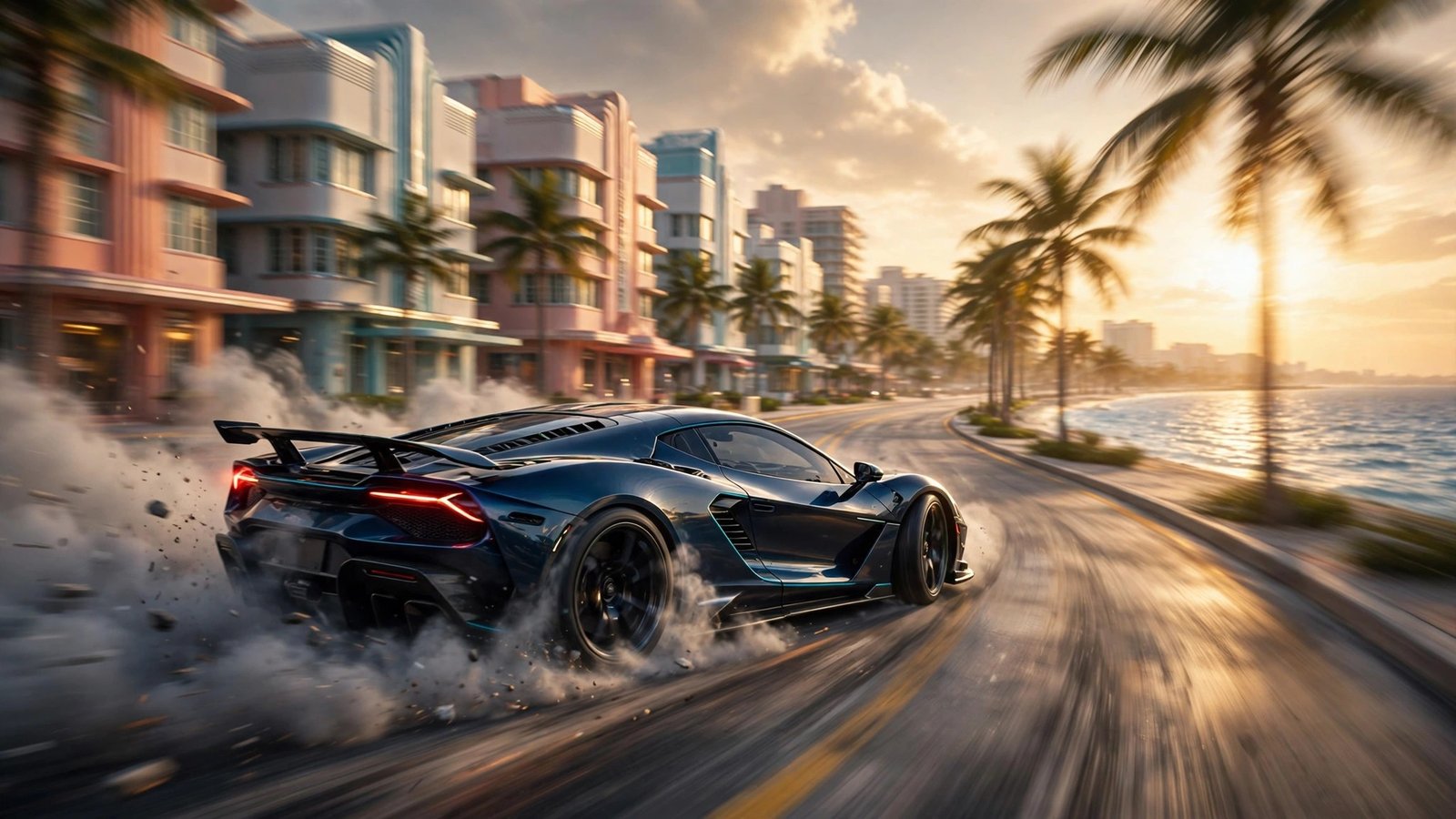
Trailer 2 is full of driving, and it is worth paying attention to how the cars move. In one sequence, a car powerslides around a corner in Vice City, tyres smoking, the body leaning into the turn. In another, Jason drives a truck down a dirt road in the countryside, dust kicking up behind it. In a third, a boat cuts across the water of the Leonida Keys. These are cinematic shots, not gameplay, and the cars are being driven by the trailer’s directors rather than by a physics engine — but they do tell us what Rockstar wants driving to look like: fast, physical, and a little bit out of control.
Trailer 1 shows the other side of driving: the everyday kind. Lucia and Jason drive through Vice City traffic, sit in jams, cruise along the beachfront. The cars look heavy and planted, not floaty. That matters, because GTA 5’s cars were often criticised for feeling too light and too grippy — every car felt like it was on rails until it suddenly was not. The trailers suggest GTA 6’s cars have more weight to them, more visible suspension movement, more sense that the car is a physical object with mass.
Again, the caveat: trailers are not gameplay. A car sliding beautifully in a trailer does not prove the handling model allows it, and a car looking heavy does not prove it feels heavy to drive. But Rockstar’s trailers are made with the game’s engine, and the studio is famously careful about what it shows. The driving in the trailers is a hint, not a promise.
How GTA Driving Has Evolved
To guess where GTA 6 is going, look at where the series has been. GTA 4’s driving was famously heavy and realistic — cars had body roll, braking distances mattered, and every turn felt like a negotiation. Some players loved it; many found it frustrating, especially in chases where a single mistake ended the mission. GTA 5 swung the other way: cars were grippy, forgiving and arcade-like, easy to control at high speed and hard to spin out. It was more fun for most players, but it lost some of the physicality that made GTA 4’s driving memorable.
Red Dead Redemption 2’s horses are the most relevant comparison, because they show how Rockstar handles vehicles now. A horse in Red Dead Redemption 2 has weight, momentum and personality: it speeds up gradually, it stumbles on rough ground, it reacts to danger, and it bonds with the player over time. Driving a horse felt like driving a living thing, not steering a box. If GTA 6’s cars borrow anything from that approach, they will feel more like machines with character — different cars behaving differently, not just faster or slower versions of the same model.
Reports have suggested that GTA 6’s driving is closer to GTA 4’s realism than GTA 5’s arcade feel, with more noticeable weight transfer, suspension and tyre grip. Those reports are unconfirmed, and they should be treated as rumours. But they fit the direction of the trailers, and they fit Rockstar’s general move toward simulation in Red Dead Redemption 2.
Different Surfaces, Different Handling
Leonida’s map is unusually varied for a GTA game, and that variety should show up in the handling. Vice City’s streets are flat, wide and fast — built for high-speed chases and powerslides. The Grassrivers, the game’s Everglades, are water and mud, where a car is the wrong tool and a boat or an airboat is the right one. Mount Kalaga National Park has steep, winding mountain roads where braking and grip matter more than top speed. The Leonida Keys are connected by long bridges, where crosswinds and narrow lanes could make driving tense.
Weather should matter, too. GTA 6’s weather system — storms, rain, humidity — is expected to be more detailed than in any previous GTA game, and wet roads should mean less grip. Our GTA 6 weather system guide explains what is known about storms and the day-night cycle. If rain genuinely changes handling, then a chase in a thunderstorm will feel very different from a chase on a dry afternoon, and that would be a real step forward for the series.
Off-road driving is the other big question. GTA 5 had off-road vehicles and dirt tracks, but they were a side activity. Leonida’s countryside — farms, swamps, forests, dirt roads — is a much bigger part of the map, and Jason’s rural life suggests off-road driving could matter more in GTA 6. A truck that handles mud differently from a sports car that handles a highway would make the map feel real, and would reward players who choose the right vehicle for the job.
Chases, the Police, and Handling Under Pressure
Driving in GTA is never just about getting from A to B. It is about getting away. The wanted system is the other half of the handling equation, because a chase tests the driving model harder than any race: you are braking late, taking corners too fast, dodging traffic, and trying not to crash while police cars ram you from behind. If the handling is too forgiving, chases are boring. If it is too punishing, they are frustrating.
GTA 6’s police AI is expected to be smarter than GTA 5’s, with officers who set up roadblocks, coordinate, and use the environment. That is not confirmed, but the trailers emphasise police behaviour, and our GTA 6 wanted system guide covers what is known. Smarter police would make handling matter more, because escaping would require driving skill, not just speed — knowing when to brake, when to cut through an alley, when to abandon the car entirely.
The two protagonists could also change how chases feel. Lucia and Jason have different backgrounds — Lucia is a driver with a history of high-speed escapes, Jason is a man who knows the back roads — and reports have suggested that their driving skills could differ. That is speculation, not confirmation, but it would be a natural way to make the two characters feel different behind the wheel.
What Players Should Expect
The honest expectation is a driving model that feels more physical than GTA 5’s and more forgiving than GTA 4’s — a middle ground that Rockstar has been working toward for years. Cars should feel heavier, with more visible weight and suspension movement. Different cars should feel different, not just in speed but in how they turn, brake and slide. And the map’s variety — city streets, country roads, swamps, mountains — should make the choice of vehicle matter.
What players should not expect is a racing simulator. GTA is an open-world action game, and driving is one part of it, not the whole game. The handling will be tuned for fun first and realism second, and that is the right call. The best GTA driving has always been the kind that feels exciting without being punishing — fast enough to be thrilling, loose enough to be forgiving, and physical enough to feel real.
Until Rockstar releases gameplay footage, though, all of this is educated guesswork. The trailers are promising, the series’ direction is encouraging, and Leonida’s map is built for great driving. But no handling model has been confirmed, and any report claiming to know exactly how GTA 6’s cars feel should be treated as a rumour until the game is in players’ hands.
Frequently Asked Questions
How will driving feel in GTA 6?
Not officially confirmed. Rockstar has not described GTA 6’s driving model or released gameplay footage. The trailers show cars with visible weight and body movement, and reports have suggested handling closer to GTA 4’s realism than GTA 5’s arcade feel — but those reports are unconfirmed.
Will GTA 6 driving be more realistic than GTA 5?
Probably, but not confirmed. GTA 5’s handling was deliberately arcade-like and forgiving. Red Dead Redemption 2 showed Rockstar moving toward more physical, weighty vehicle handling, and GTA 6 is expected to continue that direction. Whether it goes as far as GTA 4’s heavy realism is unknown.
Will weather affect driving in GTA 6?
Not confirmed, but likely. GTA 6 is expected to have a detailed weather system with rain and storms, and wet roads reducing grip would be a natural consequence. Rockstar has not confirmed whether weather changes handling, and any claim that it does is speculation until gameplay is shown.
What vehicles can you drive in GTA 6?
The trailers show cars, trucks, boats and motorcycles, and the series’ history suggests planes and helicopters will appear too. No full vehicle list has been announced. Our GTA 6 vehicles guide covers everything the trailers have shown so far.