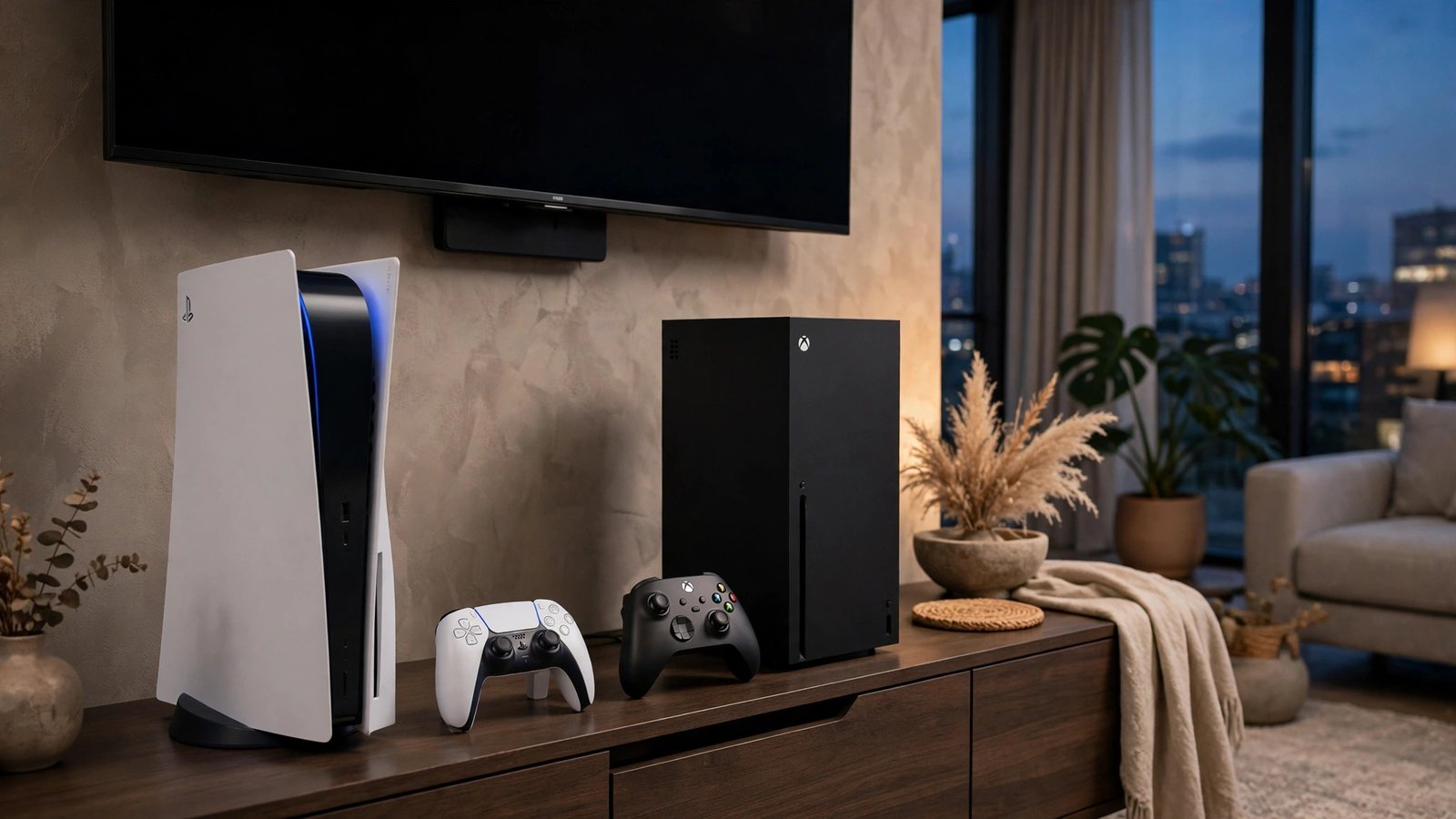
PS5 vs Xbox Series X: Which Console Should You Buy in 2026?
Five years into this console generation, the PS5 vs Xbox Series X debate is still the first question most buyers ask — and in 2026 the answer depends less on raw hardware than ever. Both machines are powerful, both have mature game libraries, and both now sit alongside mid-generation refreshes and handheld experiments. So which console should you buy in 2026? This comparison looks at the specs, the exclusive games, the subscription services, and the real-world differences that actually decide it.
The Hardware: Closer Than the Spec Sheet Suggests
On paper, the Xbox Series X holds a small power advantage. It uses a custom AMD processor with an 8-core Zen 2 CPU running at up to 3.8GHz and a GPU rated at about 12 teraflops. The PlayStation 5 counters with a similar Zen 2 CPU at up to 3.5GHz and a GPU around 10.28 teraflops — but paired with an exceptionally fast custom SSD rated at 5.5GB/s raw throughput, roughly double the Xbox’s 2.4GB/s.
What this means in real games
In practice, multiplatform games look and run almost identically on both systems. Most major titles offer a 60 frames-per-second performance mode and a higher-resolution quality mode on each console, and side-by-side comparisons usually come down to tiny resolution differences. The PS5’s faster SSD can shave seconds off loading in games built around it, while the Xbox’s extra GPU headroom occasionally shows in resolution. Neither machine will disappoint you — this round is effectively a draw.
Storage and expansion
The PS5 launched with about 825GB of storage (roughly 667GB usable); the later PS5 Slim raised this to 1TB. The Series X ships with 1TB (around 802GB usable). Both let you expand: the PS5 accepts a standard M.2 NVMe SSD you install yourself, which is usually cheaper, while Xbox uses proprietary expansion cards that are simpler to swap but often cost more per gigabyte. With modern games regularly exceeding 100GB, budget for expansion either way.
The Controllers: A Genuine Difference
Here the two philosophies split. Sony’s DualSense adds haptic feedback and adaptive triggers that change resistance depending on the in-game action — pulling a bowstring or feeling rain in a game built for it is a real, memorable effect. It has a built-in rechargeable battery, but battery life is modest at roughly 6 to 12 hours.
The Xbox controller keeps a proven, comfortable shape with excellent sticks and a hybrid D-pad. It runs on AA batteries or a rechargeable pack, which some players prefer for longevity. If you play on PC too, the Xbox pad is the native standard there. Neither is a wrong choice, but the DualSense offers the more distinctive experience.
Exclusive Games: Where the Decision Really Lives
PlayStation’s strength: big story-driven exclusives
Sony’s first-party studios are famous for cinematic single-player games. The PS5 library includes titles such as Marvel’s Spider-Man 2, God of War Ragnarök, The Last of Us Part I, Gran Turismo 7, Demon’s Souls, Ratchet & Clank: Rift Apart, and Astro Bot. Many of these eventually reach PC, but they launch on PlayStation first — sometimes years earlier. If this style of game is your favourite, the PS5 is the obvious home for it.
Xbox’s strength: breadth and day-one releases
Microsoft’s studios cover a wider spread of genres: Halo Infinite, Forza Horizon 5 and Forza Motorsport, Starfield, Gears 5, Microsoft Flight Simulator, and a growing RPG catalogue from Bethesda and Obsidian. The pattern to know for 2026 is that Microsoft now releases some titles on PlayStation as well, so “Xbox exclusive” matters less than it once did — but Game Pass (covered next) keeps the ecosystem compelling.
Subscriptions: Game Pass vs PlayStation Plus
This is where value diverges most sharply. Xbox Game Pass Ultimate includes hundreds of games, EA Play, online multiplayer, and — its killer feature — every Xbox first-party game on the day it launches. For players who try lots of games, it is arguably the best deal in gaming.
PlayStation Plus comes in tiers: Essential covers online play and monthly games, Extra adds a large downloadable catalogue, and Premium adds classic games and streaming. The catalogue is strong, especially for catching up on Sony’s exclusives, but brand-new first-party releases generally are not included on day one. If subscription value is your priority, Xbox wins this round clearly.
Backward Compatibility and Your Old Library
The Xbox Series X plays thousands of games across four generations of Xbox, and many older titles get automatic frame-rate and resolution boosts. If you own a big Xbox 360 or Xbox One library, it carries forward beautifully. The PS5 plays nearly the entire PS4 library, which is excellent, but PS3 and earlier games are mostly limited to streaming on the Premium tier or individual remasters. Collectors of older Xbox games have a clear winner here.
The Factor Nobody Puts on a Spec Sheet: Your Friends
One practical point decides more purchases than any teraflop count: buy the console your friends play on. Cross-play has improved enormously, and most big multiplayer games now connect PlayStation and Xbox players in the same matches. But party chat, shared libraries, clubs, and simply handing a friend your second controller still work best inside one ecosystem. If your group chat is full of PS5 owners, that is a genuine reason to join them; the same applies in reverse for Xbox. Also consider any library you already own digitally — PS4 games carry to PS5 and Xbox One games carry to Series X, so switching sides can mean leaving purchases behind.
Price and the 2026 Picture
Both consoles launched at $499 for the disc versions, and pricing has shifted over the generation — Sony introduced the slimmer PS5 models and a more powerful PS5 Pro at a premium price, while Microsoft has offered Series X variants including a digital-only model. Exact prices vary by region and by periodic adjustments, so check current local pricing before deciding. As a rule of expectation for 2026: the standard models trade blows on price, the PS5 Pro targets enthusiasts who want the best console image quality, and discounted bundles around sales events often decide the real winner.
Frequently Asked Questions
Which is more powerful, PS5 or Xbox Series X?
The Xbox Series X has the stronger GPU on paper (about 12 vs 10.28 teraflops), while the PS5 has the faster SSD. In real multiplatform games the difference is minimal, and most titles offer matching 60fps performance modes on both.
Which console has better exclusive games?
It depends on taste. PlayStation leads for cinematic story-driven exclusives like Spider-Man 2 and God of War Ragnarök. Xbox offers broader variety plus day-one access through Game Pass, though some Microsoft titles now also release on PlayStation.
Is Game Pass really better than PlayStation Plus?
For value, yes — Game Pass Ultimate includes new first-party games on release day, which PlayStation Plus does not. PlayStation Plus Extra and Premium are still good for a large back catalogue, particularly Sony’s own exclusives.
Should I wait for the next generation instead?
Probably not. Both libraries are mature, prices are as settled as they get mid-cycle, and no successor consoles have been officially dated. Buying in 2026 gives you thousands of games today rather than a rumoured machine tomorrow.
Conclusion
In the PS5 vs Xbox Series X choice, hardware is nearly a tie, so decide on games and services. Choose the PS5 if you love big story-driven exclusives, the DualSense controller’s features, and the fastest loading. Choose the Xbox Series X if Game Pass value, backward compatibility with older Xbox games, and one library across console and PC matter more. Either way, you are buying into a mature generation at its best point — there is no bad pick, only the pick that fits your games.




2 Comments