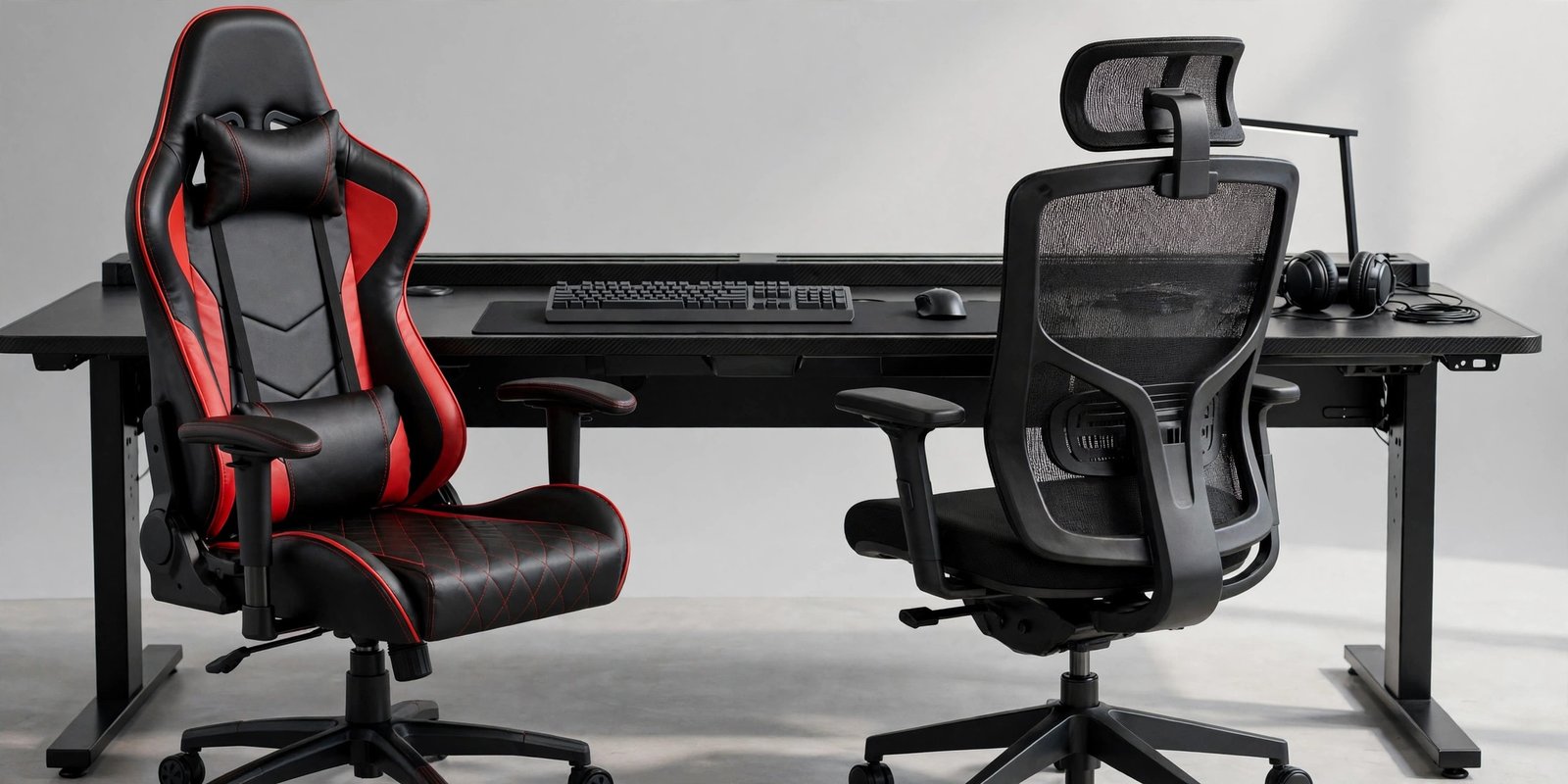
Gaming Chair vs Office Chair: Which Is Actually Better for Long Sessions?
It is the debate every gamer faces when the old chair starts squeaking: do you buy a racing-style gaming chair with bolsters and a logo, or a “boring” office chair built for eight-hour workdays? Marketing says gaming chair. Your back, after a four-hour session, might disagree. In this gaming chair vs office chair comparison, we cut through the styling and look at what actually matters for long sessions — ergonomics, adjustability, materials, and price — so you can spend once and sit comfortably for years.
Why Your Chair Matters More Than You Think
Gamers routinely sit for two to six hours at a stretch, often in worse posture than office workers, because the action pulls you forward and locks your shoulders. A bad chair quietly taxes everything: lower-back ache, neck stiffness, numb legs, and the fatigue you blame on a long day. A good chair does not just feel nicer — it supports an upright, relaxed posture so your body is not the thing that ends your session. That is the standard both chair types should be judged by.
Gaming Chairs: Strengths and Weaknesses
What Gaming Chairs Get Right
Gaming chairs are modelled on racing bucket seats, with high backs, side bolsters, and a recline that often goes nearly flat — great for controller gaming and watching cutscenes. They typically include lumbar and neck pillows out of the box, come in sizes for larger bodies, and their bold colour schemes genuinely complete a gaming setup’s look. The recline range is usually better than office chairs at the same price, and many models offer 4D armrests that move in every direction.
Where Gaming Chairs Fall Short
The bucket-seat design is also the problem. Fixed bolsters can push your shoulders inward and restrict movement, the included pillows are a generic fix rather than true adjustable lumbar support, and many budget models use bonded leather (PU) that cracks and peels within two years. The flat, firm seat pan suits some bodies and punishes others. In short, cheap gaming chairs sell a look; only the good ones deliver support.
Office Chairs: Strengths and Weaknesses
What Office Chairs Get Right
Ergonomic office chairs are engineered around one job: keeping a seated human healthy for eight-plus hours. The best use breathable mesh that never gets hot, genuinely adjustable lumbar support that fits your spine’s curve, a seat with a waterfall front edge that does not cut circulation, and a synchro-tilt mechanism that moves naturally with your body. They are also usually built to higher durability standards, with warranties of five to twelve years on premium models.
Where Office Chairs Fall Short
Office chairs rarely recline as far, which matters if you game with a controller leaned back. Headrests are often an extra-cost option or missing entirely, the styling is corporate rather than exciting, and a mesh seat feels strange to players used to cushioned foam. Top ergonomic brands are also expensive — flagship models cost more than many gaming PCs’ graphics cards, though the mid-range has improved enormously.
Head-to-Head: The Categories That Matter
Ergonomics and Lumbar Support
Office chairs win. Adjustable lumbar systems that change height and depth beat a strap-on pillow every time, and it is not close at equal prices. A gaming chair can be comfortable, but its support is largely fixed where the designer put it, not where your spine is.
Comfort for Long Sessions
For sessions over three hours, breathable mesh office chairs win on temperature and pressure distribution. For shorter, more varied sessions — switching between desk play and leaned-back controller play — a good gaming chair’s recline and headrest pillow can feel better. Honest answer: it depends on how you play, which is exactly why “best” lists without context mislead people.
Adjustability
Roughly even at mid-range prices. Gaming chairs often lead on armrests and recline angle; office chairs lead on seat-depth adjustment, lumbar tuning, and tilt tension. At premium prices, ergonomic office chairs pull ahead with more meaningful adjustments overall.
Materials and Durability
Office chairs win again. Mesh and quality fabric outlast PU leather comfortably, and office-chair warranties reflect that confidence. If you buy a gaming chair, choosing fabric upholstery over cheap PU is the single best durability decision you can make.
Price and Value
Under $200, neither category is great, but entry gaming chairs at least include headrests and recline. Between $250 and $450, ergonomic office chairs generally deliver more support per dollar, while gaming chairs deliver more features and style. Above $500, premium office chairs dominate for pure sitting health; premium gaming chairs justify themselves mainly to fans of the style and recline.
So, Which Should You Buy?
Buy an ergonomic office chair if you work at the same desk you game at, sit for long stretches, run warm, or have any history of back discomfort. Buy a gaming chair if you mostly play with a controller, love reclining between matches, want your setup to look like a setup, and will choose a reputable model with a fabric option and a real warranty. Hybrid ergonomic chairs with gaming styling now exist from several brands and genuinely split the difference — in 2026 they are worth a serious look for anyone torn between the two camps.
Before You Buy: A 60-Second Checklist
Whatever you choose, verify these: the seat height suits your desk and lets your feet rest flat, the chair is rated comfortably above your weight, the warranty covers at least two years (five is better), the upholstery matches your climate, and — most overlooked — the return policy lets you sit in it for a week, because no spec sheet can tell you how a chair fits your body.
Frequently Asked Questions
Are gaming chairs bad for your back?
Not inherently, but cheap gaming chairs with fixed bolsters and pillow-based lumbar support are worse for your back than a proper ergonomic office chair. A quality gaming chair used with good posture is fine; the risk comes from budget models that prioritise looks over adjustable support.
How long do gaming chairs last compared to office chairs?
A mid-range gaming chair typically lasts three to five years, with PU leather upholstery usually failing first through cracking and peeling. Quality office chairs commonly last seven to ten years, backed by much longer warranties — fabric and mesh simply outlast bonded leather.
What is the best chair for both work and gaming?
An ergonomic office chair with a headrest, or one of the newer hybrid chairs that combine adjustable lumbar support and mesh with gaming-style recline. These cover long workdays and evening sessions without compromise, and they have become the most popular single-chair solution for home setups.
Is a gaming chair worth it over a regular chair?
Over a basic dining or kitchen chair, absolutely — any dedicated chair with proper height, armrests, and recline is a major upgrade. The real question is gaming chair versus ergonomic office chair at the same budget, and there the office chair usually wins on support and durability.
Conclusion
The gaming chair vs office chair debate has a boring but true answer: for long sessions and back health, a good ergonomic office chair wins; for recline, style, and controller play, a quality gaming chair earns its place. Ignore the logos, check the lumbar support, upholstery, and warranty, and buy the chair that fits how you actually sit. Your future self, five hours into a session with zero back pain, will be grateful.